
What is the Logarithm?
The Greek words logos, which means proportion, and arithmos, which means number, are the inspirations for the modern term logarithm; adding them together to create the word "logarithm." The logarithm is the mathematical equivalent of exponentiation. This indicates that the exponent to which b must be raised to produce x is the logarithm of x to the base b. For example, 1000 = 10³, the logarithm base 10 of 1000 is 3, or log₁₀ = 3.
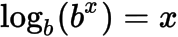
 | = | logarithmic base |
Let's now try to understand it by solving an example given below.
Example:
Solve log 2 (32) =?
Solution:
since 25= 2 × 2 × 2 × 2 × 2 = 32, therefore, 5 is the exponent value, and hence log 2 (32)= 5.
The magnitude of earthquakes is measured with logarithms. The noise levels are measured in dBs (decibels) using logarithms. Chemicals' pH levels are measured with them. In radioactivity, logarithms are primarily utilized for determining a radioactive element's half-life.
Which are the 3 Main Types of Logarithms?
Based on the logarithm's base, logarithmic functions are broadly divided into two categories. There are natural and common logarithms in our system. Normal logarithms will be logarithms to the base 'e', and normal logarithms will be logarithms to the foundation of 10.
Similarly, common logarithms, with a base of 10, binary logarithms, with a base of 2, and natural logarithms, with a base of e ≈ 2.71828, are the most prevalent types of logarithms.
Additionally, logarithms have the following four properties. - logb(xy) = logbx + logby
- logb(x/y) = logbx - logby
- logb(xn) = n logbx
- logbx = logax / logab
- logb(xy) = logbx + logby
- logb(x/y) = logbx - logby
- logb(xn) = n logbx
- logbx = logax / logab
Which are the 7 Rules of Logarithm?
Logarithm has the following 7 rules.
- Base Switch Rule
A logarithm's base is changed in the base switch rule. To better comprehend it, see the illustration below.
logb (a) = 1 / loga (b)
Example: logb 4 = 1/log4 b
- Change of Base Rule
Logb m = loga m/ loga b
Example: logb 4 = loga 4/loga b
- Derivative of Log
If f (x) = logb (x), then the derivative of f(x) is given by;
f'(x) = 1/(x ln(b))
Example: Given, f (x) = log10 (x)
Then, f'(x) = 1/(x ln(10))
- Division Rule
Logb (m/n)= logb m – logb n
For example, log5 ( 4/ y ) = log5 (4) -log5 (y)
- Exponential Rule or Power Rule
The rational exponent times its logarithm is the logarithm of m according to the exponential rule (power rule).To better comprehend it, see the illustration below.
Logb (mn) = n logb m
Example: logb(45) = 5 logb 4
- Integral of Log
We can use the integration by parts formula ∫ln x dx = xlnx - x + C to evaluate the integral of ln x, which is the integration of log x with base e. This is the formula for the integration of ln x dx. To understand it further, see the example given below.
∫logb(x)dx = x( logb(x) – 1/ln(b) ) + C
Example: ∫ log5(x) dx = x ∙ ( log5(x) – 1 / ln(5) ) + C
- Product Rule
Logb (mn)= logb m + logb n
For example, log5 ( 4y ) = log5 (4) + log5 (y)
Also Read
Comments